Newsletter Subscribe
Enter your email address below and subscribe to our newsletter
Enter your email address below and subscribe to our newsletter

 ByJohn A
Ask most people what makes a bathroom pleasant and they will mention the shower, the vanity, or the tile. The mirror rarely comes up. Yet the mirror is where people spend their most focused time, shaving, applying makeup, examining their skin. The quality of that surface and the light around it shapes the daily experience far more than its modest place in the renovation budget suggests.
In most bathrooms, light comes from the ceiling. This arrangement creates a problem few people consciously identify. Light falling from above casts shadows downward across the face, under the eyes, nose, and chin, precisely the areas you are trying to see when you lean toward the mirror. You end up judging your appearance in lighting that distorts the very features you care about. It explains why so many people feel they look better anywhere but their own bathroom.
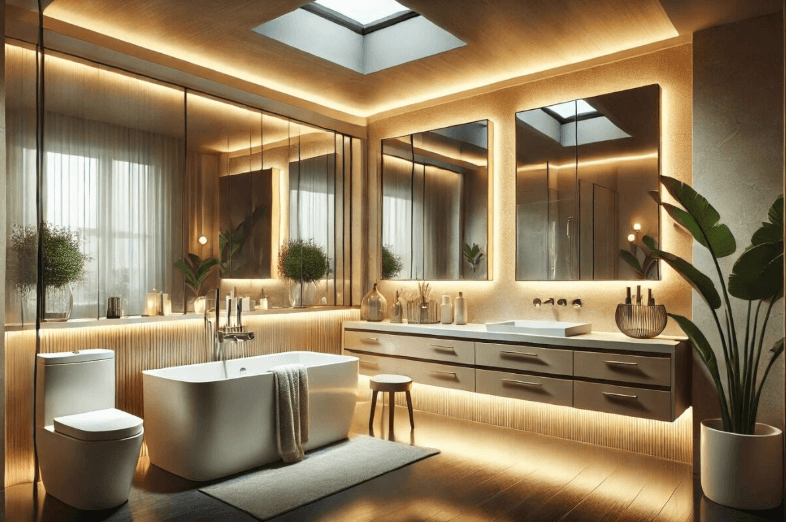
The logical solution is to light the face from the front or sides rather than from above. That is exactly what mirrors with integrated lighting do. By diffusing light around or alongside the reflective surface, they eliminate the unflattering shadows and give a faithful view of the face. Anyone wanting to solve this can learn more about mirrors that combine reflection and illumination in a single fixture, an approach that quietly fixes a problem most bathrooms have lived with for decades.
Illuminated mirrors existed before LEDs, but they were bulky, power-hungry, and gave off uncomfortable heat. LED technology transformed the category. The diodes draw very little electricity, last tens of thousands of hours, produce almost no heat, and fit into minimal thicknesses. These qualities made possible the sleek, slim, durable mirrors now widely available.
Longevity is an underrated advantage. A quality LED mirror runs for years without a bulb to replace, removing a recurring chore. In a humid room where swapping out a fixture is never pleasant, that durability is a genuine comfort. The low power draw, meanwhile, means you can leave the light on as long as you like without energy guilt. These practical benefits often matter more in daily life than the sleek looks that first attract buyers.
Not all LED light is equal. Color temperature, measured in kelvins, determines whether the light leans warm or cool. Warm light around 2700 to 3000 kelvins feels relaxing but can distort color perception, which is a problem for anyone applying makeup. Cool light above 5000 kelvins renders color accurately but can feel harsh and clinical.
For a bathroom, the sweet spot generally falls between 4000 and 4500 kelvins, a neutral white that shows colors faithfully without being severe. Some LED mirrors even offer adjustable temperature, letting you shift from warm and relaxing to neutral and functional depending on the moment. This flexibility suits the different uses of the room, from an unhurried evening to a rushed morning. Choosing the right color temperature, or an adjustable one, has more impact on the mirror’s usefulness than almost any other feature.
Beyond lighting, modern mirrors bundle in features that improve daily life. The anti-fog system, usually a heating element behind part of the mirror, keeps a section clear even after a hot shower, ending the smeary business of wiping fog away by hand. This unglamorous feature turns out to be one of the most appreciated in daily use.
Some models add touch controls, dimmers, and even built-in charging ports. These deserve a discerning eye, though. The most genuinely useful are anti-fog and dimming, while others edge toward gimmickry. The wise buyer chooses features that match real habits rather than accumulating options that will never be used. A mirror loaded with functions you ignore is just a more expensive mirror.
A poorly sized mirror throws off the whole wall composition. The general rule keeps the mirror slightly narrower than the vanity, creating a balanced proportion. A mirror too small looks lost above a wide counter, while one too large overwhelms the room. Getting this proportion right is a simple matter of measurement, but it is easy to skip.
Mounting height matters as well. The center of the mirror should sit at roughly eye level for the average user, which sometimes means a compromise in a household of varying heights. An LED mirror adds a further consideration: electrical supply at the intended location, ideally planned during the renovation itself. Adding that wiring after the fact complicates installation and can compromise the clean look the mirror is meant to provide.
See also: Home Heat Options When a Full Sauna Heater Will Not Fit
Mirror format answers different needs depending on the bathroom. The simple flat mirror maximizes reflective surface and suits most layouts. A mirrored medicine cabinet combines reflection with storage, a valuable solution in small spaces where every centimetre counts. It hides medications and products behind a clean surface while still serving as a mirror. The trade-off is depth, since the cabinet projects further from the wall than a flat mirror.
Some bathrooms also benefit from a separate full-length mirror, distinct from the vanity mirror, for checking an outfit before heading out. This kind of mirror needs no integrated lighting but usefully rounds out the space. The choice among these formats depends on available space and household habits. Pairing an LED mirror above the vanity with a full-length mirror elsewhere answers both the need to see your face clearly and the need to see yourself head to toe.
Because an LED mirror is an electrical device installed in a wet room, safety deserves a mention. The connection must meet local code, and the supply should be protected by a breaker suited to damp locations. Entrusting this wiring to a qualified electrician ensures a safe, lasting installation. This is not a place for improvisation, since water and electricity make an unforgiving combination. Planning the electrical supply during the renovation, while the walls are open, is far easier and safer than retrofitting it later.
The mirror perfectly demonstrates how a discreet element can transform the experience of a room. A good LED mirror does more than reflect. It lights the face correctly, resists fog, lasts for years, and integrates cleanly into the bathroom. These benefits, hard to appreciate from a catalog image, register every single day in use.
In a bathroom renovation, it would be a shame to perfect the vanity, the tile, and the shower only to neglect the one element you spend the most focused time in front of. Giving the mirror the thought it deserves, weighing the lighting, the features, and the proportions, completes a well-executed bathroom. It is often exactly this kind of considered detail that separates a room that was merely renovated from one that is genuinely a pleasure to use.